Quick answer
Scrape out loose food, wash the warm skillet by hand with hot water and a small amount of mild dish soap, dry it completely over low heat, then wipe on a very thin layer of cooking oil and buff away the excess. Never leave cast iron soaking or wet in storage. Treat rust and failing seasoning as a separate restoration job.
The easiest way to clean a cast iron skillet is to make the same short routine part of cooking: scrape, wash, dry and oil. The pan does not need a complicated ritual after every meal, but it does need one thing you cannot negotiate with—complete dryness before it goes away.
This guide is for everyday cleanup after frying, sautéing or baking. It also explains what to do when food is stuck on, when a little black residue appears, and when the pan has genuine rust. Those are different problems, and treating them as one is how a five-minute wash becomes an unnecessarily aggressive restoration project.
The everyday cast-iron cleaning routine
1. Scrape while the pan is still warm
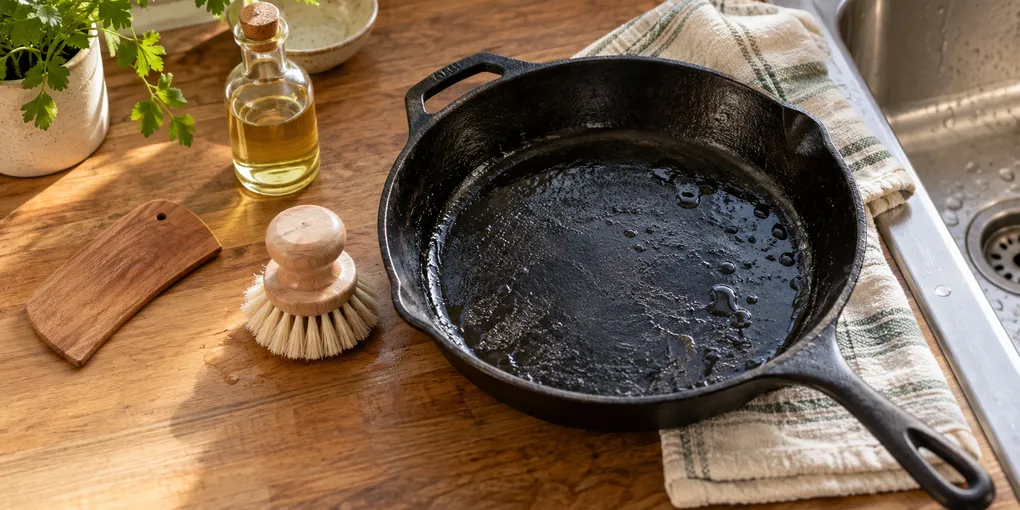
Move leftover food into the bin or compost, then use a wooden or plastic pan scraper to lift loose bits. A warm surface usually releases residue more easily than a cold one. Do not pour cold water into a smoking-hot pan; set it aside for a moment if it is extremely hot so the metal and your hands are not shocked by the temperature change.
2. Wash by hand
Run warm or hot water into the skillet and scrub with a soft sponge, nylon brush or stiff-bristled dish brush. A small amount of mild dish soap is fine for normal cleanup. The practical goal is to remove grease and food, not to sterilize the pan by force or polish away every dark mark.
For a skillet with ordinary seasoning, avoid leaving it submerged in the sink. Cast iron can rust when moisture sits against it, and a long soak does not improve the cleaning result enough to justify that risk. The manufacturer routine from Lodge Cast Iron is simply wash, dry and oil.
3. Loosen stubborn food with a short simmer
If a thin layer of egg, sauce or caramelized food will not release, add enough water to cover the stuck area and bring it to a brief simmer on the stovetop. Turn off the heat, let the pan cool to a safe handling temperature, and scrape again. Pour the dirty water out, scrub and rinse.
This is a targeted loosening step, not a reason to boil the pan for a long time. If food is still welded on, repeat once with a little coarse salt as gentle abrasion. Skip harsh oven cleaner or a full stripping treatment unless the problem is rust or severely damaged seasoning.
4. Dry completely, including the rim and handle joint
Wipe the skillet with a clean, lint-free towel. Then place it over low to medium-low heat for a few minutes until all visible moisture has evaporated. Pay attention to the pouring lip, underside and the area where the handle meets the bowl. A pan can look dry inside while a drop remains in a seam or textured edge.
Turn the heat off before the next step. If the handle is hot, use a dry mitt and keep the pan away from children and flammable towels.
5. Oil lightly and buff
Put a few drops of neutral cooking oil—such as canola, vegetable or grapeseed oil—on a paper towel or clean cloth. Wipe a very thin layer over the cooking surface, sides and rim. Then use a fresh part of the towel to buff until the surface looks satiny rather than wet.
Too much oil is not extra protection. A sticky, tacky finish usually means the layer was too heavy or the pan was stored before the excess was removed. The best post-wash coating is almost invisible.
What to do about black residue
A dark skillet is normal; a smear of loose black material on food or a towel is a signal to investigate. First wash the pan again with hot water, mild soap and a brush. If the residue is food, it should lift. If the surface is sticky, gummy or flaking, the seasoning may be uneven and needs more attention than a routine wash.
Do not assume that every dark patch is seasoning that must be stripped. A normal cast-iron surface can be mottled, matte or nearly black. The useful test is whether it is stable and clean after washing, not whether it matches a showroom photograph.
When the skillet has rust
Rust is a restoration problem, not everyday grime. Small surface spots can be scoured with a suitable scrubber, followed by washing, thorough drying and a thin coat of oil. More extensive rust may require reseasoning. Serious Eats’ restoration guide is useful context because it treats stripping and rebuilding as a separate project from ordinary care; Lodge’s care instructions describe scouring, oiling and oven reseasoning for more serious cases.
If you reseason, follow the temperature and time instructions for your particular pan and use good ventilation. Never store a freshly oiled pan while it is wet, and never put bare cast iron in the dishwasher.
Common mistakes to avoid
- Leaving the skillet to soak overnight.
- Putting it in the dishwasher.
- Air-drying it beside the sink.
- Applying a thick, sticky layer of oil.
- Using abrasive stripping methods for ordinary cooked-on food.
- Storing it while moisture remains under the rim or handle.
The Kitchn’s side-by-side test of five cleaning methods is a helpful reminder that popular cast-iron advice is full of competing rules. A consistent, low-effort routine is easier to repeat and less likely to damage a pan than chasing every clever hack.
A useful habit for the next meal
Keep a scraper near the stove, a dedicated brush by the sink, and a clean towel within reach. After cooking, scrape while warm, wash briefly, dry over heat and buff in the thinnest possible film of oil. That is enough for most skillets. If the pan is rusty, sticky or actively shedding residue after that routine, stop repeating the routine and move to a deliberate restoration plan.
For adjacent kitchen-care routines, see our guides to cleaning an air fryer and cleaning a blender, or make cleanup easier by organizing a small kitchen.
Frequently Asked Questions
Can you use dish soap on a cast iron skillet?
Yes. A small amount of mild dish soap is suitable for normal cleaning. Scrub gently, rinse, dry completely and apply a thin film of oil. The bigger risks are prolonged soaking, air-drying and damp storage.
How do you clean stuck-on food from cast iron?
Scrape first, then add a little water and simmer briefly to loosen the residue. Turn off the heat, let the pan cool enough to handle safely, scrub, rinse and dry it thoroughly. Avoid attacking a normal skillet with aggressive stripping chemicals.
How do you clean rust from a cast iron skillet?
Rust needs a deeper reset: scour the affected area, wash and dry the pan, oil it and reseason if the damage is extensive. Do not confuse a rusty pan with a skillet that simply has a patch of cooked-on food.