Quick answer
Sort decorations by how you will use them, clean and dry everything before packing, protect fragile or shape-sensitive pieces, wind lights around a support, label each container on two sides, and place the items you need first where you can reach them. Keep paper, textiles, candles and electronics dry, and follow the care instructions for artificial trees and specialty pieces.
Storing Christmas decorations well is less about buying the perfect box and more about making next year’s unpacking obvious. If lights are tangled, ornaments are mixed together, and the wreath is crushed under a heavy bin, the work has only been postponed. A useful system protects the pieces you care about and tells you where each category belongs.
The reliable order is: sort, clean, dry, protect, label, then place. Keep the system simple enough to repeat, and make the first box you will need the easiest one to reach.
The short storage routine
Before packing, gather containers, tissue paper or other clean cushioning, cardboard, a marker, labels, and a phone for quick inventory photos. Then:
- Sort decorations by the way you use them, not only by object type.
- Remove batteries from items that will sit unused, following the product instructions.
- Wipe dust away and let fabric, greenery, and surfaces dry fully.
- Separate fragile, sharp, crushable, heat-sensitive, and oddly shaped pieces.
- Wind lights and ribbon around a support instead of dropping them loose into a bin.
- Label the container on the lid and one side, then record where it lives.
Do not pack in a rush while anything is wet. Moisture trapped in a closed container can leave textiles musty and damage paper, finishes, or metal parts. If an item has a care label or manufacturer instructions, those take priority over a general storage tip.
1. Sort for retrieval, not perfection
Make four broad groups: first-out decorations, room or display groups, fragile pieces, and overflow or seasonal craft supplies. “First-out” might include the tree stand, lights, hooks, and the decorations used in the entryway. Keeping those together can save more time than sorting every ornament by color.
Next, remove pieces that are broken, unsafe, or no longer used. Photograph a complicated arrangement before dismantling it, and note missing bulbs, hooks, or adapters in your inventory. The goal is not to preserve every object indefinitely; it is to make a deliberate decision before an item disappears into storage.
2. Protect each material differently
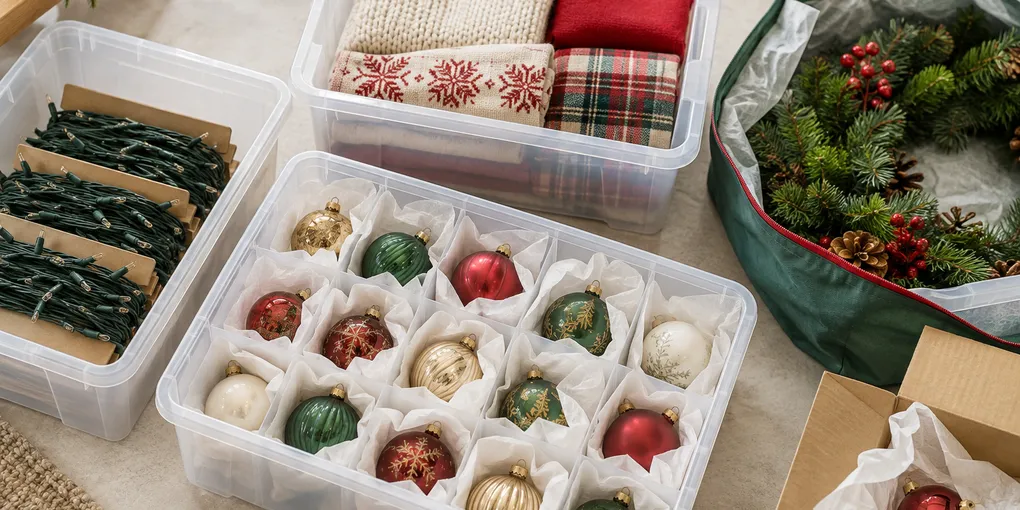
Wrap glass and delicate ornaments individually in tissue or clean soft packing material. Dividers are useful because they stop pieces from knocking together. Do not put heavy objects on top of fragile ones, and leave enough room that the lid does not press down on raised details.
Keep fabric items, paper decorations, and ribbons clean and completely dry before folding them loosely. Avoid compressing bows and shaped textiles under heavy boxes. If a piece is valuable or has special care instructions, store it according to its label rather than assuming a plastic tote is suitable.
Artificial trees and wreaths need protection from crushing and dust. Use a correctly sized bag or container and avoid forcing branches into a shape they cannot hold. A wreath can hang from a suitable hanger if that does not damage it; otherwise use a box that lets it lie without pressure.
Candles should be kept flat in a cool, dry place, away from heat and direct sun. Battery-powered decorations should be switched off and checked according to their instructions; removing batteries before long storage helps prevent leakage, but keep the batteries with the item only if the manufacturer’s guidance supports that arrangement.
3. Stop lights and garland becoming a knot
Test each light strand before winding it. Mark a strand that failed so it does not become next year’s mystery problem. Cut a rectangle from sturdy cardboard, make small notches near the ends, and wrap the cable in a loose, even path. The notches can hold the plug and the far end without tight kinks.
A wrapping-paper tube or coat hanger can work for longer strands. Do not wind so tightly that the cable, bulbs, or decorative wire bends sharply. Place each finished bundle in a shallow layer, or stand it where heavier items cannot crush it. Label the destination—“tree,” “window,” or “outdoor”—so you do not need to unravel every bundle to find the right one.
4. Use labels that answer three questions
Every label should say: what is inside, where it is used, and whether it needs care. For example: “Living room — glass ornaments — top shelf” or “Outdoor lights — test before use — dry indoor bin.” Put a label on the lid and on a vertical side because lids move and stacked containers hide them.
If you have many boxes, number them and keep a short note or photo album on your phone. Record the storage location, not an elaborate catalog. A photo of the open bin can be more useful than a list when you are looking for one specific ornament.
5. Choose the storage location carefully
Use the driest, most stable place available. A garage, attic, basement, or shed may be convenient but can expose decorations to moisture, heat, cold, pests, or large temperature changes. Keep paper, textiles, candles, electronics, and sentimental pieces indoors when the outside storage area is not reliably dry.
Keep containers off a damp floor and away from leaking pipes. Do not block a door, electrical panel, heater, or access route. Put heavy bins low and fragile or first-out bins at a comfortable height. A small home can use shallow under-bed containers, a closet shelf, or one clearly marked seasonal zone; a large home benefits from grouping decorations by room so unpacking follows the decorating route.
A five-minute closeout check
Before you finish, open every container once. Confirm that nothing is damp, batteries are handled, lights are supported, fragile pieces are cushioned, and the label matches the contents. Take one photo of each open bin, close the lids without forcing them, and write down any replacement or repair for the next shopping trip.
That final check turns storage into a handoff to your future self. When the next holiday arrives, you should be able to find the first-out bin, lift it safely, and start decorating without buying replacements for items that were simply lost in an unmarked box.
For a broader home reset, pair this seasonal pass with a practical closet decluttering routine, a small-bathroom organization plan, or a home inventory for insurance.
Sources
Frequently Asked Questions
Should Christmas decorations be stored in plastic or cardboard boxes?
Use a clean, dry container that suits the item. Lidded plastic bins are useful for many decorations and make contents easier to protect, while sturdy reused cardboard can work for light, dry items kept in a dry indoor location. Do not seal damp textiles or greenery.
How do you stop Christmas lights from tangling in storage?
Wind each tested strand around a piece of cardboard, a wrapping-paper tube, or a coat hanger. Secure the ends gently, label the location or use, and place the bundle where it will not be crushed.
Where should Christmas decorations be stored?
Choose the driest practical location with stable conditions and no blocked exits. Keep fragile, paper, textile, candle and electronic items indoors when a garage, attic or shed is damp, very hot, or prone to large temperature swings.