Quick answer
If you can get completely off the traffic lane onto firm, level ground, switch on your hazard lights, engage the parking brake and follow the owner's manual for the jack points. Loosen the wheel nuts before lifting the car, raise it only enough to clear the ground, fit the spare, tighten the nuts in a star pattern, and drive slowly to a tire shop; if the location is unsafe or the tire or wheel is badly damaged, stay belted in the car and call roadside assistance.
A flat tire is annoying, but the roadside is not a workshop. The first question is not “Where is the jack?” It is “Can I get the car and myself completely away from moving traffic?” If the answer is no, turn on the hazard lights, stay belted in the vehicle and call roadside assistance.
This guide is for a normal car with a usable spare wheel and a factory jack. Your owner’s manual wins over any generic instruction: it shows the approved lifting points, the wheel-nut torque and the limits for your particular spare. The AAA tire-changing guide also recommends using the vehicle’s manual and placing the jack against the frame or approved lifting point, not body panels.
The pre-lift decision gate
Do not lift the car until every answer below is “yes.” One “no” changes this from a short repair into a roadside-assistance call.
| Check | Pass condition | If it fails |
|---|---|---|
| Traffic | The entire vehicle and work area are separated from moving traffic | Stay belted in with hazards on and call for help |
| Ground | The car is on firm, level ground with room to work | Do not jack it on a slope, soft shoulder or blind bend |
| Equipment | The manual, correct jack point, usable jack, wrench, key and suitable spare are available | Do not improvise a lift or fastener |
| Damage | The wheel, replacement tire and fasteners appear usable | Request an inspection or recovery |
| People | Passengers, children and pets can remain outside the work area | Keep them away or stop the repair |
This gate is deliberately conservative: it helps decide whether the generic steps apply before a vehicle is raised. The owner’s manual and local roadside rules still control the repair.
1. Reach a genuinely safe stopping place
If you feel a tire lose pressure, ease off the accelerator and keep the steering straight. Avoid sudden braking. Move as far from traffic as the road allows, preferably into a parking area, wide shoulder or other firm space that is fully separated from moving vehicles.
Switch on the hazard lights before you stop. Do not change a tire in a live traffic lane, on the outside of a blind bend, immediately beside a narrow motorway lane or on soft ground. A few minutes saved by attempting a dangerous repair are not worth the risk. The Pennsylvania Driver’s Manual safety guidance lists a spare, jack, lug wrench, flashlight, reflective equipment and wheel wedges among useful vehicle supplies.
2. Find the spare, jack and wheel key
Put the car in Park, or in first gear/reverse if it has a manual transmission. Engage the parking brake and switch the engine off. Take the spare, jack, lug wrench, locking-wheel-nut key, gloves and flashlight out before you begin. A reflective vest or warning triangle can improve your visibility, but never stand in traffic to place one.
Read the manual now, even if you have changed a tire before. Some cars have a jack hidden beneath the boot floor, a spare mounted underneath, or no spare at all. Electric cars and vehicles with unusual suspension may have specific lifting instructions. Do not guess where to place a jack.
3. Inspect the flat and identify the replacement
Look at the failed tire without crawling underneath the car. A screw or small tread puncture is different from a torn sidewall, a separated tread, a cracked wheel or a tire that came off after hitting a pothole. Sidewall and wheel damage usually means professional recovery, not a quick spare swap.
Check whether your replacement is a full-size spare or a compact “donut.” Read its sidewall for pressure, speed and distance markings. A compact spare is an emergency bridge to a repair shop, not a permanent replacement. The NHTSA’s tire-safety guidance stresses that tires, including spares, need correct pressure and attention to age and condition.
4. Secure the car before lifting it
Keep passengers on the side away from traffic, and keep children out of the work area. On level ground, place wheel wedges or solid chocks against a wheel that will remain on the ground. If you have no chocks, do not substitute loose objects that can roll or break.
Confirm that the car is stable, the parking brake is on and the jack will sit on firm, level ground. Never try to change a tire on a steep slope. Never put any part of your body under a vehicle supported only by its emergency jack.
5. Remove the cover and loosen the nuts
If the wheel has a hubcap or trim cover, remove it using the tool supplied with the car. Fit the lug wrench fully onto the first nut and turn counter-clockwise. Loosen every nut about one turn while the flat tire is still touching the ground. Do not remove the nuts yet.
If a nut will not move, check that the wrench is fully seated and that you are turning the correct way. Do not jump on a short factory wrench or use a long improvised pipe beside traffic. A seized locking nut, missing key or damaged nut is a good reason to call for help before lifting the car.
6. Position the jack at the approved point
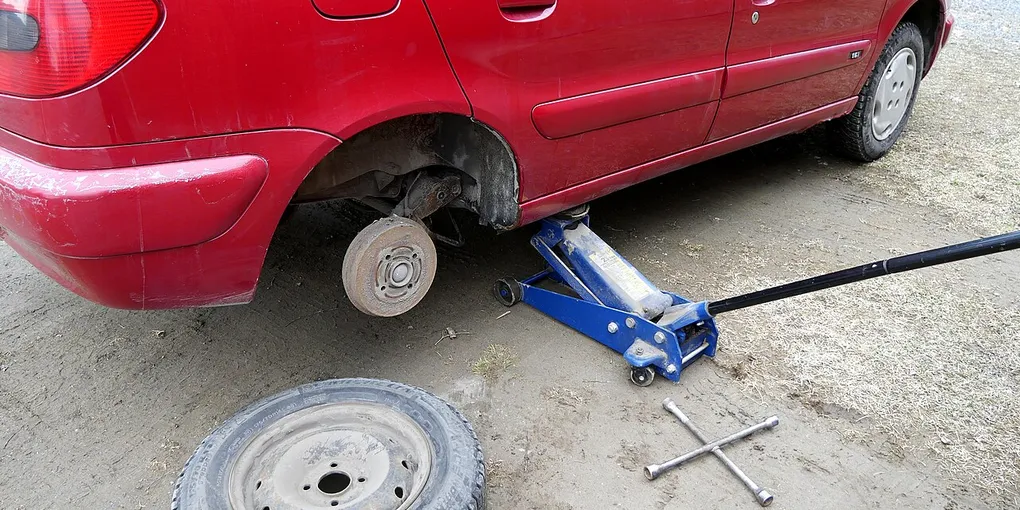
Find the marked jack point in the manual or on the vehicle’s sill. Place the jack straight under that point, with its base flat and its head seated correctly. Keep the handle clear of traffic and your feet clear of the car’s path if the jack shifts.
Raise the car slowly until the flat tire is only slightly clear of the ground—just enough to remove it and fit the spare. Keep watching the base and the contact point. If the car leans, the jack sinks or anything moves unexpectedly, lower it if you can do so safely and stop the job. A jack is for lifting, not for holding a car while someone works underneath it.
7. Remove the flat wheel
Finish unscrewing the loosened nuts by hand and place them somewhere clean. Grip the tire with both hands and pull it straight toward you. Do not put fingers behind the wheel where they can be pinched against the hub.
If the wheel is stuck to the hub, keep the car stable and use only the method described in the owner’s manual. Do not hit a raised wheel with a hammer or kick it beside an unsupported car. If it will not release without force, roadside assistance is safer.
8. Fit the spare and hand-tighten
Line up the spare’s holes with the wheel studs or hub, then push it fully into place. Start each nut by hand so you do not cross-thread it. Tighten the nuts lightly in a star or criss-cross pattern rather than tightening neighbours in a circle.
The spare must sit flat against the hub. If a nut spins freely, a stud is damaged, the wheel does not seat or the spare is the wrong size, lower the car carefully and stop. Never try to solve a fit problem by forcing the nuts.
9. Lower the car and tighten evenly
Lower the car until the spare touches the ground but still carries very little weight. Tighten the nuts in the star pattern again. Then lower the car completely, remove the jack and finish tightening each nut in the same alternating order.
The correct final torque is the value in the owner’s manual or on the vehicle information label; a torque wrench is the best way to verify it. Refit the hubcap only if it fits without touching the temporary spare. Stow the flat tire, jack and tools securely so they cannot become projectiles during braking.
10. Drive directly to a tire shop
Before moving, check that the spare is inflated to the vehicle’s specified pressure, all nuts are present and the jack is out of the road. Drive gently to a tire shop or other repair location. Keep well below the temporary spare’s marked limit, avoid sudden steering and braking, and do not treat a donut as a normal tire for a long journey. Recheck the nuts and pressure as soon as practical.
A full-size spare still needs inspection: it may be old, under-inflated or intended only for emergency use. The NHTSA tire-safety page notes that tire condition and pressure matter even when the tire is not used every day. Replace or repair the original tire promptly rather than leaving the spare on for weeks.
When not to change the tire yourself
Stop and call for professional help when any of these apply:
| Situation | Safer choice |
|---|---|
| The car cannot get fully away from traffic | Stay belted in with hazards on and call roadside assistance |
| You are on a slope, soft shoulder or unstable ground | Do not jack the car; request recovery |
| The sidewall, tread or wheel is torn or bent | Have the tire and wheel professionally assessed |
| The spare, jack or locking-nut key is missing | Do not improvise a lift or wheel fastener |
| Two tires are flat, or the spare is also damaged | Request a service vehicle |
| The car uses a sealant kit and the damage is outside its instructions | Follow the manual or call for help |
A tire change is a short repair only when the location, equipment and vehicle all cooperate. Prepare before the next trip: check the spare’s pressure, locate the jack points, and keep a flashlight and gloves with the kit. If you are planning a longer drive, the road-trip planning checklist and its vehicle check are useful preparation; for a dead battery rather than a flat tire, use the separate safe jump-start guide.
Hero image: Santeri Viinamäki, CC BY-SA 4.0, via Wikimedia Commons.
Sources
Frequently Asked Questions
Is it safe to change a tire on the side of the road?
Only if the vehicle is completely off the traffic lane on firm, level ground and you have enough room to work without standing near moving vehicles. Turn on hazard lights, engage the parking brake and keep passengers away; if you cannot reach a genuinely safe place, stay belted in the car and call roadside assistance instead.
Should I loosen the lug nuts before jacking up the car?
Yes. With the flat wheel still on the ground, loosen each nut about one turn with the lug wrench, but do not remove them. Once the car is supported at the correct jack point and the tire is just off the ground, remove the nuts and wheel.
How fast can I drive on a temporary spare tire?
Follow the speed and distance limits printed on the spare and in your owner's manual. Many compact temporary spares are limited to 50 mph (80 km/h) and short emergency use, but the exact limit varies; drive directly to a tire shop and avoid hard cornering, heavy loads and high speeds.
What if my car has no spare tire?
Use the manufacturer's inflator or sealant kit only when its instructions match the puncture and tire, and never use sealant for a sidewall tear, a separated tread or a damaged wheel. If there is no suitable repair kit or the location is unsafe, call roadside assistance rather than improvising.