Quick answer
Cloudflare's MIT-licensed security-audit-skill gives a tool-using coding agent a structured way to audit a codebase: map the target, hunt by coverage area, validate candidates independently, write schema-checked findings, and report what remains uncertain. Install it only for a repository you are authorized to inspect, use an OS-enforced sandbox, and treat every result as a lead until a human verifies the threat model and evidence.
cloudflare/security-audit-skill was #1 on GitHub’s daily Trending page when checked on September 19, 2026. GitHub showed 3,162 stars today, about 16,000 total stars, and 874 forks. That is a record of attention, not a security certification. The useful question is whether the repository gives you a safer, more auditable process than an unstructured request to “find vulnerabilities.”
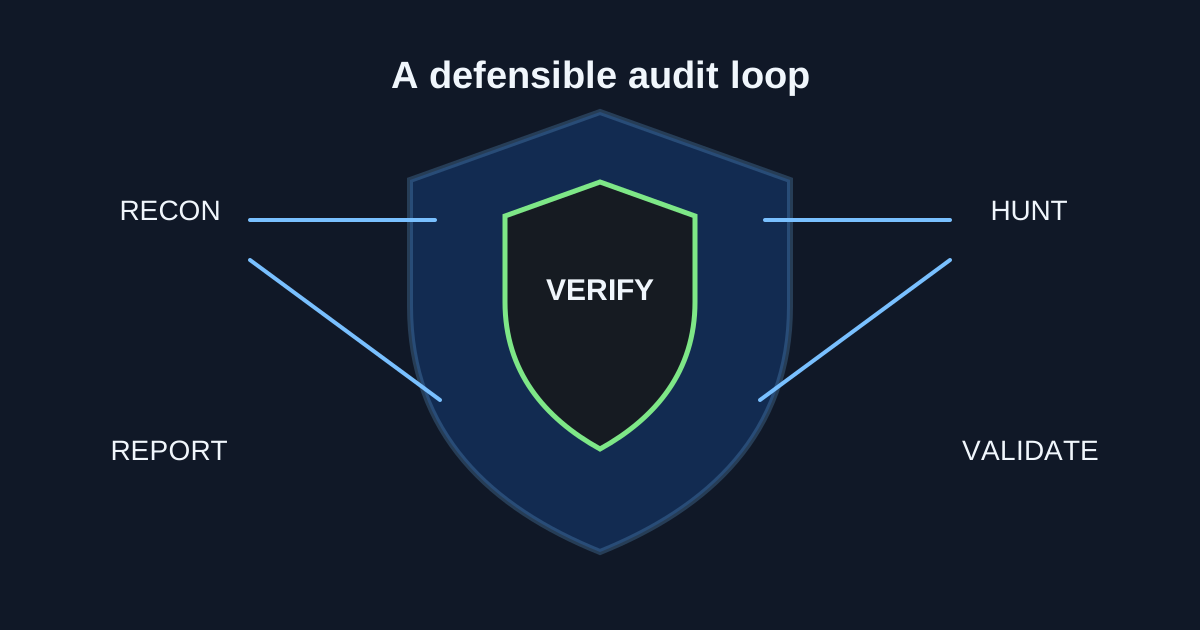
Cloudflare’s answer is a six-phase workflow: reconnaissance, coverage-led hunting, candidate validation, structured output, independent record verification, and target-neutral reporting. The repository is MIT licensed, but permission to read or modify code is a separate question. Use it only on a codebase you are authorized to audit, and keep the output directory outside the project or in an ignored path.
What the skill actually adds
The skill is a set of instructions, companion checklists, and zero-dependency validators for a tool-using coding agent. It does not turn an ordinary model into a proven vulnerability scanner, and the README does not promise complete coverage. Instead, it supplies a repeatable shape for an investigation:
| Phase | Practical question | Useful artifact |
|---|---|---|
| Reconnaissance | What is this application, and where are its trust boundaries and inputs? | architecture.md |
| Coverage-led hunting | Which attack classes and code areas have actually been examined? | coverage-ledger.json |
| Candidate validation | Can a fresh agent disprove this candidate? | validated finding record |
| Structured output | Can another tool parse the result consistently? | findings.json and report-schema.json |
| Independent verification | Does a separate pass agree with the cited source and claim? | verified finding or needs_validation |
| Reporting | What should a human read and act on? | REPORT.md and detail files |
That separation is the article’s most useful takeaway. A long AI report is not evidence by itself. A finding should have a target, an attacker story, a boundary or assumption that is crossed, and evidence that another person can inspect. The repository’s three verdicts—confirmed, needs_validation, and rejected—are more honest than forcing every interesting observation into a severity ranking.
Install it without widening the trust boundary
The repository documents this installation command:
npx skills add https://github.com/cloudflare/security-audit-skill \\
  --skill security-audit
Add --global only when you deliberately want the skill available to every project for that user. Before running it, inspect the current repository README and the installer output. The project requires Node.js for its validators, a coding agent with tool use and parallel sub-agents, and an OS-enforced sandbox that disables external networking, sanitizes the environment, limits resources, and restricts writes to assigned scratch paths.
Those requirements are not decorative. An audit agent may compile code, run tests, start local services, or inspect files containing secrets. A sandbox should make target-controlled execution bounded and observable. If your environment cannot enforce those boundaries, keep the result at needs_validation and do not let the agent execute untrusted build steps. Never paste API keys into an audit prompt, and never point the workflow at a production checkout just because it is convenient.
Run a small, read-only first pass
Start in a disposable clone or a repository snapshot. Then use a narrow request that states the target and output location:
Audit this repository for exploitable vulnerabilities.
Use the ignored directory ./security-audit-output for artifacts.
Do not modify tracked files, contact external services, or access credentials.
Show the threat model and evidence for every candidate.
The repository also documents shorter prompts such as security audit this codebase and find security vulnerabilities in ./src. The more explicit version is easier to review because it makes the no-write and no-network boundary part of the task rather than leaving it to implication.
Before accepting a report, check these items:
- The output directory is ignored, disposable, and separate from the source tree you intend to review.
- The agent did not edit tracked code to make a proof of concept pass.
- Each claimed vulnerability identifies an attacker, an action, an impact, and the boundary that failed.
- File paths, functions, line references, and schema validation resolve against the same revision that was audited.
- Dynamic evidence is labelled as dynamic evidence; source-only reasoning is not described as a reproduced exploit.
- A human owns the final severity, remediation, and decision to disclose or fix anything.
Read the results as leads, not verdicts
Cloudflare’s engineering write-up explains why this caution matters. The released skill grew from a single-repository workflow, while the company’s larger harness added persistence, cross-repository tracing, deduplication, and a separate validation system. Cloudflare says repeated runs found different bugs and that a single run captured only part of the total set. That is a reason to schedule thoughtful follow-up work, not a reason to claim a percentage of vulnerabilities found.
Use findings.json as a structured index into the human-readable report. Start with confirmed, then inspect the source trace and proof-of-concept evidence. Read needs_validation as a queue of exact unknowns: perhaps the deployment configuration is missing, the attacker needs an unavailable role, or the runtime behavior must be tested in an isolated harness. Treat rejected as useful history because it prevents the next run from repeating a disproved idea.
The strongest workflow is adversarial in two directions. The hunter must try to establish a concrete exploit, while a fresh validator must try to break that explanation. If the only support is “this pattern is usually dangerous,” the result is a review note or a request for more evidence—not a confirmed vulnerability.
When this repository is a good fit
This is a good fit for a team that has a codebase, permission to test it, and enough engineering context to review the output. It is especially useful when you want a repeatable record of coverage and a clear distinction between confirmed, unresolved, and rejected candidates.
It is a poor fit for a first-pass checklist with no threat model, a scan of someone else’s code, or an attempt to outsource a high-stakes security decision to an agent. It also cannot replace dependency intelligence, deployment review, secret management, threat modeling with system owners, or a professional assessment where the risk warrants one.
For a broader look at how reusable AI-agent workflows are packaged, compare our Matt Pocock skills guide. For application-level controls and device boundaries, our practical home IoT security guide is a different kind of security task with a different evidence standard.
Bottom line
Cloudflare’s security-audit-skill is interesting because it treats audit quality as a chain of evidence: map the target, cover it deliberately, challenge candidates, validate structured records, and show a human what remains uncertain. Install the MIT-licensed repository from its source, run it against an authorized disposable copy inside a real sandbox, and preserve the distinction between a useful lead and a verified vulnerability. The workflow can make an agent’s work more inspectable; it cannot make an unverified report true.
Sources
- GitHub daily Trending repositories
- cloudflare/security-audit-skill repository and README
- Cloudflare: Build your own vulnerability harness
- Cloudflare security-audit-skill MIT license
- Get Claude Skills secondary listing
Hero image: Original conceptual diagram created for Lejnel.com; no third-party assets used.